Egyptian Texts between materiality, social practice, and ritual affairs
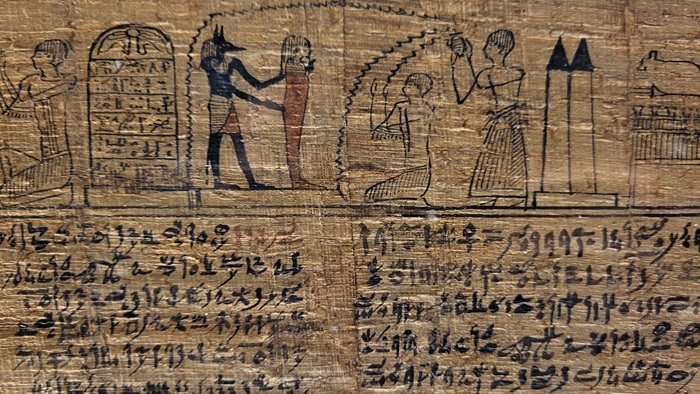
Based on prepared readings about Egyptian literacy and its conventions, the philologists of the International Doctorate Program “Philology” became acquainted with the mediality, conventions, and applications of hieroglyphic writing. From votive epitaphs and funerary texts that were repeatedly revised over several millennia, to illegible “pseudoglyphs” from the Roman period, a wide spectrum of Egyptian hieroglyphic writing was encountered at the Egyptian Museum. The visit raised questions about various applications of writing and scribal culture. Special emphasis was placed on the relation between the scribe and the text, as well as the impact of the text on its viewers. The group was particularly fascinated to learn that writings could acquire agency and power as efficacious artefacts on their own, without being connected to a scribe or requiring literacy.
Hieroglyphs and Cult Objects
Besides hieroglyphs in different kinds of cursive handwritings, the philologists admired one of the few surviving falcon-shaped cult statues from Egypt. In an exhibition of many anthropomorphic coffins and a long papyrus book of the dead, Erik Kiesel (JMU Würzburg), one of the doctoral students, also used two objects from the museum to outline the foundations of his doctoral project.
We would like to sincerely thank Prof. Martin Stadler as well as the team of the State Museum of Egyptian Art for the interesting insights!
Text: Erik Kiesel, doctoral student at the International Doctorate Program “Philology”